

Enterprise AI projects rarely stall because the technology fails. More often, they hit governance and accountability barriers after a successful pilot. Jean-François Clercx explains why ownership needs to be designed into AI initiatives from the start, and what changes when governance becomes part of the build process.
Key takeaways
- The "ownership vacuum" means no single leader owns the outcome, keeping most AI projects stuck for 6–18 months after a successful pilot.
- Build-first, govern-later creates compliance blockers that kill good work, even when the AI itself performs well.
- Governance built into the process from the start is what gets AI to production. The results prove it: 50%+ efficiency gains versus 5–10% with tooling alone.
I've sat in a lot of enterprise AI conversations over the past eighteen months. The pattern is almost always the same. AI Pilot results come in: good numbers, strong use case; the team has done real work. The room is energized. And then someone asks a few questions that change everything: Who is accountable for the outputs it generates? What cost structure do we have in place? Is it compliant with all our regulations? Where do we stand in terms of security? The silence that follows is never comfortable, because AI governance is not optional, and our clients know this.
In my work at Mimacom, I see what the numbers back up in practice: only 33% of enterprise AI pilots ever reach production. In 2025, the average abandoned initiative cost $7.2 million.
When we take a closer look at why, the answer is rarely the technology. The primary obstacle is what analysts are calling an ownership vacuum: when data scientists own the experiment, but no business leader owns the outcome. Without this, there is no one with the authority or accountability to make the production decision. That gap (not model performance, not data quality, not infrastructure) is what keeps most AI projects stuck in pilot purgatory for six to eighteen months.
Often, companies frame this as a technology scaling problem. Based on what I see across client conversations, it is an accountability architecture problem. And the two require very different solutions.
A conversation I keep coming back to
A few months ago, I had a conversation with a customer that stayed with me. The head of support at a large enterprise company had spent three months building an AI application with his team. It automated a significant part of their internal support workflow. The business loved it. His team was proud of it. It never went live. Not because it didn't work – it got blocked at the governance stage. The IT governance team asked the right questions: What data is the model working with? How are decisions logged? What happens when it produces an output that affects a customer interaction, and someone asks why?
Nobody had built the application to answer those questions. The AI was solid. The accountability infrastructure wasn't there. And that is a very different kind of failure and a much more expensive one than the technology not working. I don't think this happens because teams are careless – it's genuinely hard to design for accountability before you know what you're building. Governance gets added at the end because it has to wait for something to govern.
The accountability question nobody prepared for
40% of board directors named AI as the most challenging issue to oversee in 2026. What boards are grappling with is exactly what I keep seeing in client conversations: when an AI system produces an output that affects a customer decision, a business process, or a regulatory filing, who answers for it?
Three audiences will eventually ask that question: legal, the client, and central IT governance. In my experience, they find each other eventually. But this is usually when there is already a problem that blocks the AI from creating value.

Legal, the client, and IT governance always find each other. The question is whether your AI project survives that conversation.
Jean-François Clercx, VP Customer Success & Strategic Alliances, Mimacom
Why AI value comes from people who take ownership
The data behind this is worth reflecting on. Google Cloud's DORA 2025 report found that 70% of AI transformation value comes from people, processes, and organizational change, not from the technology itself. Yet only 37% of organizations had invested significantly in change management, incentives, or training alongside their AI deployments. That gap between where the value actually comes from and where the investment actually goes is a challenge regarding accountability, ownership, and overall governance.
And current developments are adding to it: growing client due diligence requirements, growing regulations such as the EU AI Act, and increasingly structured central IT governance frameworks are all moving in the same direction: the accountability bar is rising faster than most build processes have adapted.
What governance built-in actually looks like
I want to give you a concrete example rather than a principle.
Earlier this year, Mimacom worked with a German SaaS company in HR tech. They provide a recruiting platform running across more than 2,000 job portals, managing five distinct code base variants, with a development team that had already started adopting AI tools informally. The challenge was a familiar one: AI adoption was happening, but without structure. No governance framework, no guidelines for personal data, no framework for the EU AI Act. Every change risked regressions that only surfaced in production.
What we built with them wasn't a set of tools dropped into the existing workflow. It was a transformation that started with governance as a design constraint, not the last step.
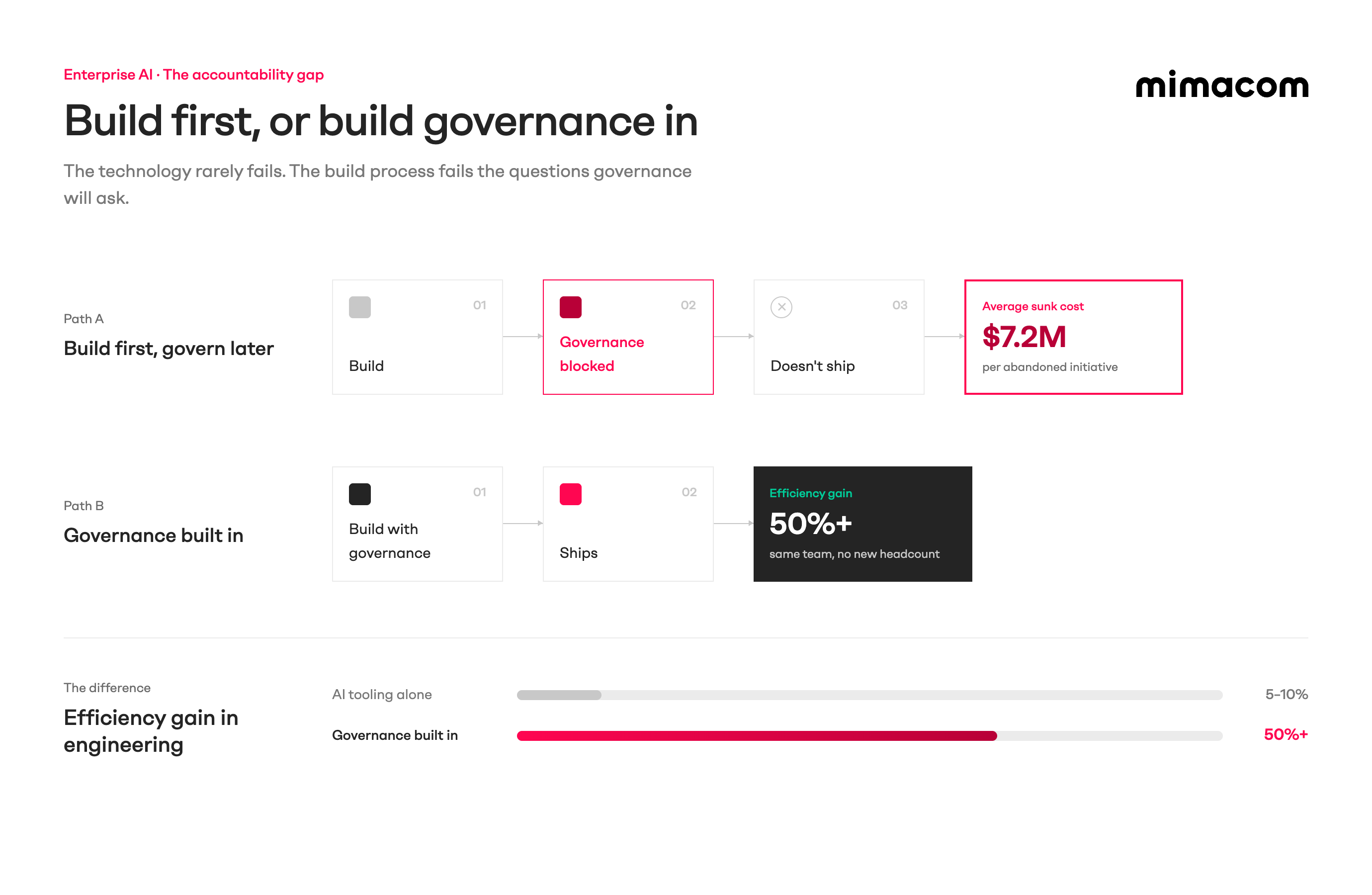
First measurable results came in eight weeks. Engineering efficiency improved by more than 50% – same team, no additional headcount. Teams that had adopted AI tooling without transforming the workflow were seeing 5 to 10% gains. The difference was not the technology. It was whether governance was designed in from the start or added on at the end.
The accountability question is only going to get harder to ignore
The EU AI Act. Rising client due diligence expectations. Increasingly structured central IT governance. These aren't trends that are going to ease up.
The AI applications can go live quickly. They just need a different starting point. That's the shift I think most enterprise teams need to make; not a bigger governance step at the end, but a different starting point. The teams that build with accountability in mind from the start will ship. They'll see better results. They'll spend less time in the cycle of build, block, rebuild. The ones that continue to bolt governance on at the end will keep running into the same wall.
If you're navigating this, if you're building AI capabilities inside your organization and running into the accountability problem, I'd be glad to talk it through.
