

Ricardo Pla Pons explores how shared AI foundations and AI-assisted delivery can reduce repeated work across enterprise applications. Drawing on Mimacom’s AI Hub, he shows how this approach can shorten time to value, strengthen governance, and improve the business case for a wider range of use cases.
Key takeaways
- Treating every AI use case as a separate project creates repeated technical, governance, and maintenance costs.
- Shared foundations give new applications a head start, while AI-assisted delivery accelerates the work that remains.
- Faster delivery brings working solutions to users sooner, shortening both time to market and time to value.
- Mimacom built 13 applications in six months, saving 113 hours each week and reducing delivery effort by 66% across five projects.
AI projects often begin with the same fundamental questions: Which models can the application use? How will it access company data? Who can use it? How will activity be monitored? How will the organization control cost, risk, and quality?
These questions are necessary, but answering them separately for every application creates a significant delivery burden. Teams spend time rebuilding the same foundations, delivery slows, and smaller use cases can become difficult to justify even when they address a clear operational need.
The real opportunity goes beyond building individual AI applications faster. It lies in creating a delivery model where each new application benefits from the work already completed, while AI accelerates the design and construction of the solution itself. Mimacom has put these principles into practice with our own AI Hub, which brings those two advantages together through reusable foundations and AI-assisted software delivery.
In the following sections, I will look at where repeated effort enters the delivery process and how the AI Hub model can shorten the path from idea to measurable value. By the end, you will have a clearer way to assess whether your current approach is built to scale or simply producing a series of isolated use cases.
The hidden work behind an AI application
When people picture an AI application, they usually think about the part they can see, such as a copilot, an intelligent search tool, or an automated workflow. The visible application, however, is only the top layer of the system.
Before it can be used safely and reliably, teams may need to decide where it will run, which data it can access, and how users will be authenticated. They may also need to establish security and governance, model routing, retrieval and memory, observability, and prompt or agent operations.
Engineering teams are well aware that these are not secondary details. They determine whether an application can move beyond a prototype and operate in a real business environment. They also account for a significant share of the work that takes place before users experience any benefit.
Most users will never see this work. They will only see whether the application gives them a useful answer, completes a task, or helps them make a better decision. From a business perspective, however, time and budget are already being spent before the application begins solving the problem it was created for.
Why separate projects create repeated costs
This hidden work becomes particularly expensive when every AI use case is treated as an isolated project. One team may establish a method for connecting models to internal data, while another creates its own access controls and a third designs a separate approach to monitoring quality, usage, and cost.
Each project may solve its immediate problem, but the organization pays for similar work several times. Knowledge remains within individual delivery teams instead of becoming an organizational capability that can support future applications.
This repetition can also create inconsistencies. Applications may use different security controls, integration patterns, monitoring tools, or governance processes, even when they operate within the same organization and depend on similar technical capabilities.
The cost is not limited to development hours. Repeated technical reviews can slow approvals, separate infrastructure can increase maintenance effort, and different controls can make oversight more difficult. A successful prototype may also require substantial rework before it can be used more widely.
This does not mean every AI application should use an identical architecture. A customer-facing assistant, an internal search tool, and an autonomous agent may have very different users, data requirements, and risk profiles.
The goal, therefore, is not to standardize everything. It is to identify the capabilities that do not need to be reinvented each time, while keeping each application tailored to the workflow and business need it serves.
A shared foundation gives every application a head start
This was the thinking behind the AI Hub. The AI Hub is Mimacom’s operating model for AI-native software delivery. It combines shared technical foundations, a reusable platform, AI-assisted development practices, and a growing portfolio of business applications within one delivery approach.
Rather than approaching each application as a new technical environment, the Hub brings common capabilities into a shared delivery model. The model has four connected layers: foundations, platform, agents and copilots, and solutions. The lower layers provide reusable technical capabilities, while the upper layers apply them to specific workflows and user needs.
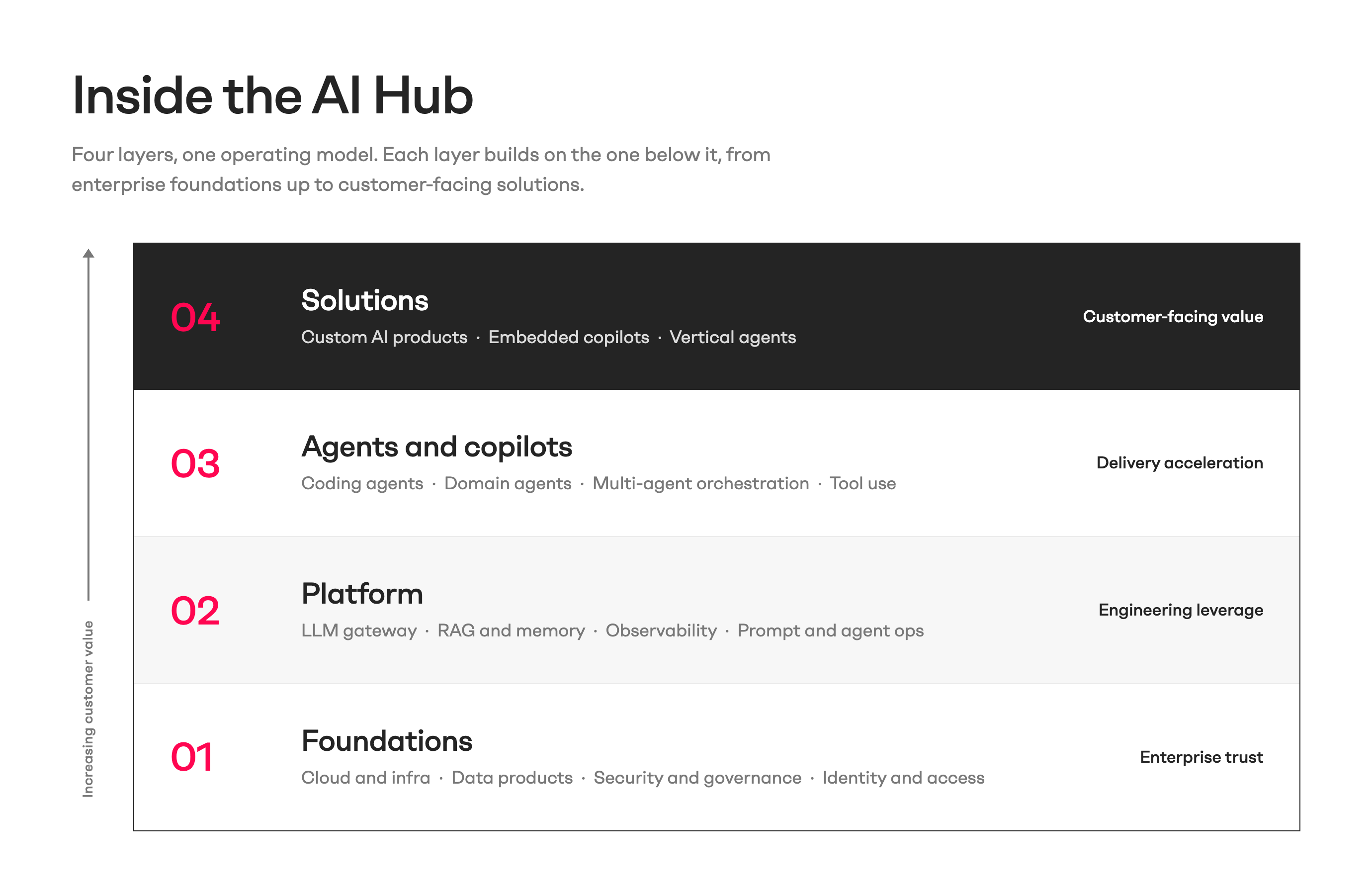
The foundations cover areas such as infrastructure, data, security, governance, identity, and access. The platform provides capabilities including model gateways, retrieval, memory, observability, and prompt and agent operations.
The upper layers use these capabilities to create coding agents, domain agents, embedded copilots, and custom AI products. Each application still addresses a specific business problem, but it does not need to begin with a blank architecture.
This reduces setup work, but reuse is only one source of efficiency. The AI Hub also applies AI directly throughout software delivery, supporting activities such as scoping, coding, testing, and iteration.
Teams build AI into the final product and use it to construct the product more efficiently. Reusable foundations reduce the work that must be repeated, while AI-assisted delivery reduces the time required for the work that remains.
Together, these advantages shorten time to market by helping teams release working solutions sooner. More importantly, they shorten time to value because users can begin testing the application, identifying improvements, and generating measurable benefits earlier in the investment cycle.
Think of it this way: many of us were excited when AI meant we would no longer have to spend hours coding boilerplate. The AI Hub applies the same logic across the wider delivery process, extending the efficiency gains beyond coding alone.
The aim, however, is not speed for its own sake. It is to reach useful evidence faster. A working application in users’ hands shows whether the problem is important enough, whether the proposed solution fits the workflow, and whether further investment is justified.
The portfolio effect
The strongest evidence for this model comes from using it internally. Over six months, Mimacom built a portfolio of enterprise applications supporting different operational areas of the company, including sales, talent management, project delivery, demand management, presales, and supplier processes.
Nine applications are already in production, two are in early access, and two more have been scoped as the next wave. Each application addresses a specific business need while building on a shared foundation.
The value of this shared AI foundation becomes clearer as the portfolio grows. The first application may require new capabilities, delivery patterns, or governance decisions, while the next application can benefit from that work.
Over time, teams develop a more reliable understanding of how to connect data, manage model access, monitor performance, and move applications into production. Each project still has its own purpose and requirements, but it no longer needs to solve every underlying problem independently.
The result is a cumulative advantage. Previous investments continue to contribute to new applications rather than remaining locked inside a single project, increasing the return on the foundations already in place.
Changing the economics of smaller use cases
Many operational problems are easy to recognize but difficult to justify as standalone software projects. A task may take an employee 45 minutes, a review may require several hours, or a reporting process may depend on copying information between spreadsheets.
The inefficiency is real, but the expected return may not support a traditional development project with separate infrastructure, integrations, security reviews, and ongoing maintenance. Smaller opportunities therefore remain in the backlog, even when they affect work every day.
Shared foundations and AI-assisted delivery change that calculation. When the cost and effort required to reach a working application fall, a wider range of use cases becomes viable to test.
The results across the AI Hub portfolio show what this can mean in practice:
|
Task |
Before |
After |
|
Talent Letter Editor |
1 hour |
20 minutes |
|
Security Checklist review |
6 hours |
10 minutes |
|
Talent Vault search |
45 minutes |
3 minutes |
|
Importing a new profile |
1 hour |
10 minutes |
|
Project Health KPIs from Excel |
1 hour |
15 minutes |
Individually, these may appear to be narrow process improvements, but across regular use, they contribute to 113 hours saved each week in selected talent, profile, and process workflows.
The value extends beyond reducing the time spent on each task. Employees receive information sooner, reviews move forward faster, and skilled people spend less time searching, copying, or checking information manually.
The same delivery model also changes which ideas are worth investigating. Not every use case will prove valuable, but reducing the cost of testing makes it possible to reach that conclusion through evidence rather than assumption.
Governance should accelerate delivery
All that said, it is impossible to make a credible case for speed without acknowledging the need for control. As the push for AI transformation continues, governance has become one of the main concerns surrounding enterprise AI. The pressure to move faster is real, but so are the questions around data access, model behavior, accountability, cost, and regulatory risk.
That is why governance needs to sit at the center of the delivery model, not appear as a final check once an application has already been built. When every project establishes its own controls and review processes, the organization repeats work that could have been addressed earlier. Adding governance only after a prototype is complete can also lead to delays, extensive redesign, or a solution that cannot move into production.
.png?width=825&height=825&name=Ricardo-Pla-Pons-Grey%20(2).png)
Governance needs to sit at the center of the delivery model, not appear as a final check once an application has already been built.
Ricardo Pla Pons, AI BU Director, Mimacom
A shared foundation offers a more practical approach. In Mimacom’s AI Hub, security, governance, identity, access, and observability sit beneath the application layer, allowing these requirements to shape delivery from the beginning rather than being added later.
This does not make every approval automatic or every risk identical. It creates a more consistent starting point, helping teams test ideas within defined boundaries while specialists retain oversight of the capabilities that require central control.
Successful prototypes then have a clearer path toward production because core operational and governance requirements have already been considered. Done well, governance supports speed by reducing uncertainty and avoiding preventable rework.
Is your AI delivery model built to scale?
A company can build several successful AI applications without having a repeatable delivery model. The problem usually appears when demand grows, and teams begin solving the same questions around data, access, governance, and monitoring again.
At that point, the real test is whether each project strengthens the organization’s ability to deliver the next one. Shared foundations can remove repeated setup work, while AI-assisted delivery can accelerate the work that remains. Mimacom’s AI Hub brings those elements together. Across five projects, work traditionally estimated at 3,360 hours was completed in 1,146 hours, a reduction of 66%.
In the end, the first test of a scalable AI delivery model is simple: does every new application start by repeating the same work, or does it benefit from capabilities and knowledge the organization has already built?
The goal is not to standardize every application. It is to stop rebuilding what does not need to be unique, so each new use case can reach value faster.
.png?width=255&height=255&name=Ricardo-Pla-Pons-Grey%20(2).png)