

We didn't just close a data gap. We built something the client now relies on every day. That's what makes this project matter to me.
Marius Niemeyer, Senior Project Manager, Mimacom
Every material in a vehicle has to match what was specified, what a supplier actually delivers, and what regulators require – three things that don't always agree. For one of the world's leading car manufacturers, closing those gaps meant a slow, manual review across thousands of components per vehicle. Mimacom rebuilt the process, automated 80% of the reconciliation, and cut a multi-day review down to two and a half hours.
The challenge
Every vehicle exists twice. Once in a manufacturer's own design and engineering systems, and once in the supplier material declarations submitted to the industry-wide IMDS database. The two records describe the same physical part, but they are not built to talk to each other: one written for engineers, the other for material and substance data.
Reconciling them has always meant manually clicking through both systems and comparing the results in spreadsheets, part by part.

Every car has about 10,000 parts. Comparing all of them is a huge challenge.
Josef Sevcik, Material Science Engineer, Mimacom
That's exactly the gap our global automotive manufacturing customer needed to close – and the pressure mounted quickly. A wave of EU regulation, from end-of-life vehicle rules to the Battery Passport, the Critical Raw Materials Act, and expanding hazardous-substance reporting, meant the client needed to prove exactly what every part contained, on demand.
At the same time, semiconductor shortages and volatile sourcing markets added a second, faster-moving risk: knowing which products and production lines depended on which materials, suppliers, and countries, before a shortage hit.
The solution
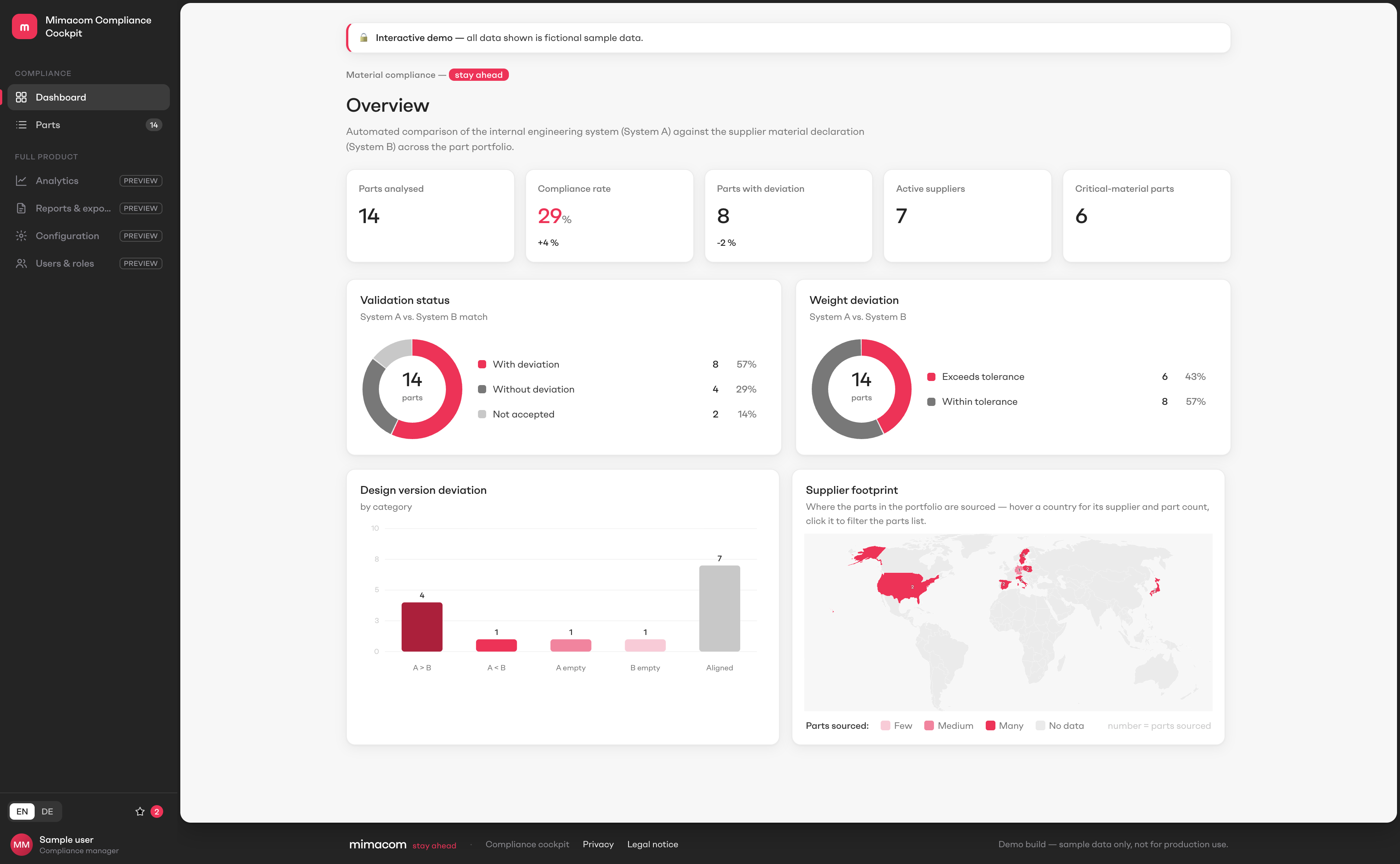
Mimacom built an integrated compliance platform that automatically correlates the customer's own design data with what suppliers report through IMDS, and layers in outside chemical and regulatory databases to determine compliance. Where a part used to require two separate lookups and a manual comparison, the platform now runs that comparison continuously, for every part, and surfaces only what actually needs a person's attention.
-
Automated matching between design records and supplier material declarations, part by part.
-
AI-assisted deviation detection by weight, material, structure, and drawing revision, grouped by material class for faster review.
-
Automated cross-referencing against external chemical databases to flag substances of concern.
-
A searchable, filterable view of the full parts catalog, by any attribute a part has, from semiconductor content to critical raw materials to EUDR-relevant materials.
-
Delivered by a lean, senior team using AI-assisted development to adapt weekly as requirements evolved.
Since going live in late 2025, the platform's scope has grown well beyond its original focus, and it keeps expanding: later this year, it will also start reading directly from scanned engineering drawings, recovering part information that was never captured digitally at all for some parts.

How it works
The same physical part looks completely different depending on which system describes it; take something as ordinary as an armrest button.
1. What a car owner sees: A tactile button that's wrapped in soft leather.
2. What the design system sees: The same button, reduced to material codes and weights: an aluminum alloy core, a leather cover, a plastic housing, each with a specified weight and little else.
3. What the supplier's material declaration sees: The same components, broken down into individual substances and their exact share by weight, tanning agents, pigments, alloy trace elements. The list is far more granular than the design system ever captures.
4. What the platform does: The platform automatically correlates every view of the same part, flags where design and supplier data disagree on weight, material, structure, or drawing revision, and traces any mismatch back to the exact sub-component causing it. Work that used to mean clicking through two separate systems by hand now happens automatically, for every part, continuously.
What's inside
-
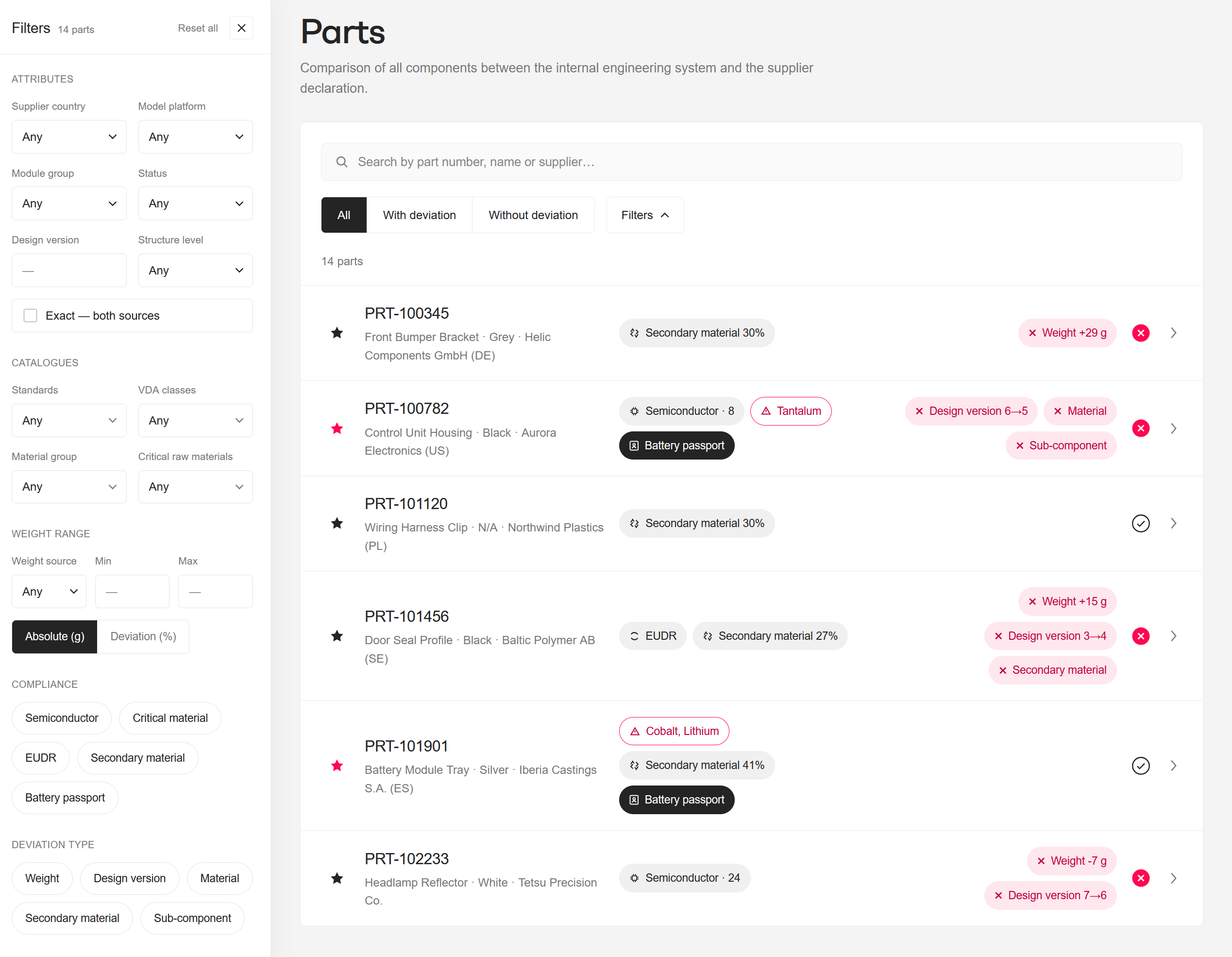
A unified view of every part, including its different versions and color variants, and every supplier's material declaration side by side (a single part can be sourced from more than one supplier), along with the context that matters for compliance and approvals: plant, vehicle series, drawing revision, and publication date.
- Automated deviation detection across weight, material, structure, and drawing revision, grouped by material class so reviewers see patterns, not just a flat list of mismatches.
- Root-cause tracing, so a flagged part points straight to the specific sub-component actually causing the mismatch, instead of leaving someone to dig it out.
- Search and filtering at scale across the full parts catalog, by any attribute a part has, with one-click views already built for the most common ones: semiconductor content, critical raw materials, secondary materials, and EUDR-relevant materials.
- Country-specific thresholds, handled individually, since a single regulation doesn't always mean a single rule. Some requirements vary by country, and the platform checks against the right one instead of applying a single blanket rule.
- AI-assisted matching for the hard cases, cross-referencing external chemical databases to work out what a component most likely is even when the source data never says so directly.
- A live compliance dashboard, with data-quality and deviation metrics that update continuously, plus export for offline review and reporting.
-
Continuous lifecycle monitoring, so newly submitted supplier data is checked automatically as it arrives, keeping the picture current without a manual re-run.
The impact
What used to take days now takes about two and a half hours. The automaker can analyze an entire vehicle series' material compliance in a single afternoon, work that once meant a week of manual cross-referencing.
The value goes beyond speed. Supply chain risk becomes something the business manages proactively, knowing exactly which products and production lines depend on which materials, suppliers, and countries, instead of finding out during a shortage. Consistent, audit-ready compliance data reduces exposure to regulatory penalties, instead of scrambling to reconstruct records after the fact.
And catching a data error early heads off a real safety and certification risk: engineering teams run virtual crash tests against the weight and structure recorded in the design system, so if a part's actual weight differs from what that system assumed, the test was validating a car that doesn't quite exist.
The same reconciliation protects the business commercially, too: if a supplier reports a lower secondary-material share than the design system assumed, the business may be paying for material that was never delivered; if it's higher, that's value left on the table. Either way, the same platform surfaces the mismatch and routes it to whoever owns that part, on top of what it means for compliance.
-
Reduced compliance analysis time from days to about 2.5 hours for an entire vehicle series' material data.
-
Automates up to 80% of design-to-supplier data reconciliation, beating an initial 70% target.
-
Helped the automaker successfully support a major internal compliance audit.
-
Tracks ELV, EUDR, the Battery Passport, critical raw materials, and hazardous substances on one platform.
-
Used daily by a growing number of people across compliance, engineering, and sourcing, and now requested by other parts of the business beyond the original team.

This is a massive enablement for people who previously either didn't have the expertise to do this work at all or had to wait on input from others, resulting in error-prone manual work.