
Key Takeaways
-
Regulatory complexity for manufacturing companies is growing faster than most IT landscapes can keep up.
-
Fragmented material data is the biggest operational risk, not a lack of regulatory knowledge.
-
Up to 80% of manual data reconciliation can be automated with an integrated compliance platform.
-
Material compliance is increasingly becoming a strategic control parameter with a direct influence on sourcing, product development, and market access.
-
The Digital Product Passport is no longer a vision of the future, but the technical data basis is often not ready.
In my work with global manufacturing and industrial companies, I repeatedly encounter a pattern: the issue of material compliance is usually treated internally as a cost factor, a necessary evil that ties up resources without creating visible added value. I consider this view to be a strategic mistake.
The pressure is increasing – and it's coming from all sides all at once
Anyone working in the manufacturing industry today is familiar with the trend. Regulatory requirements are increasing, becoming more complex, more networked, and more time-critical.
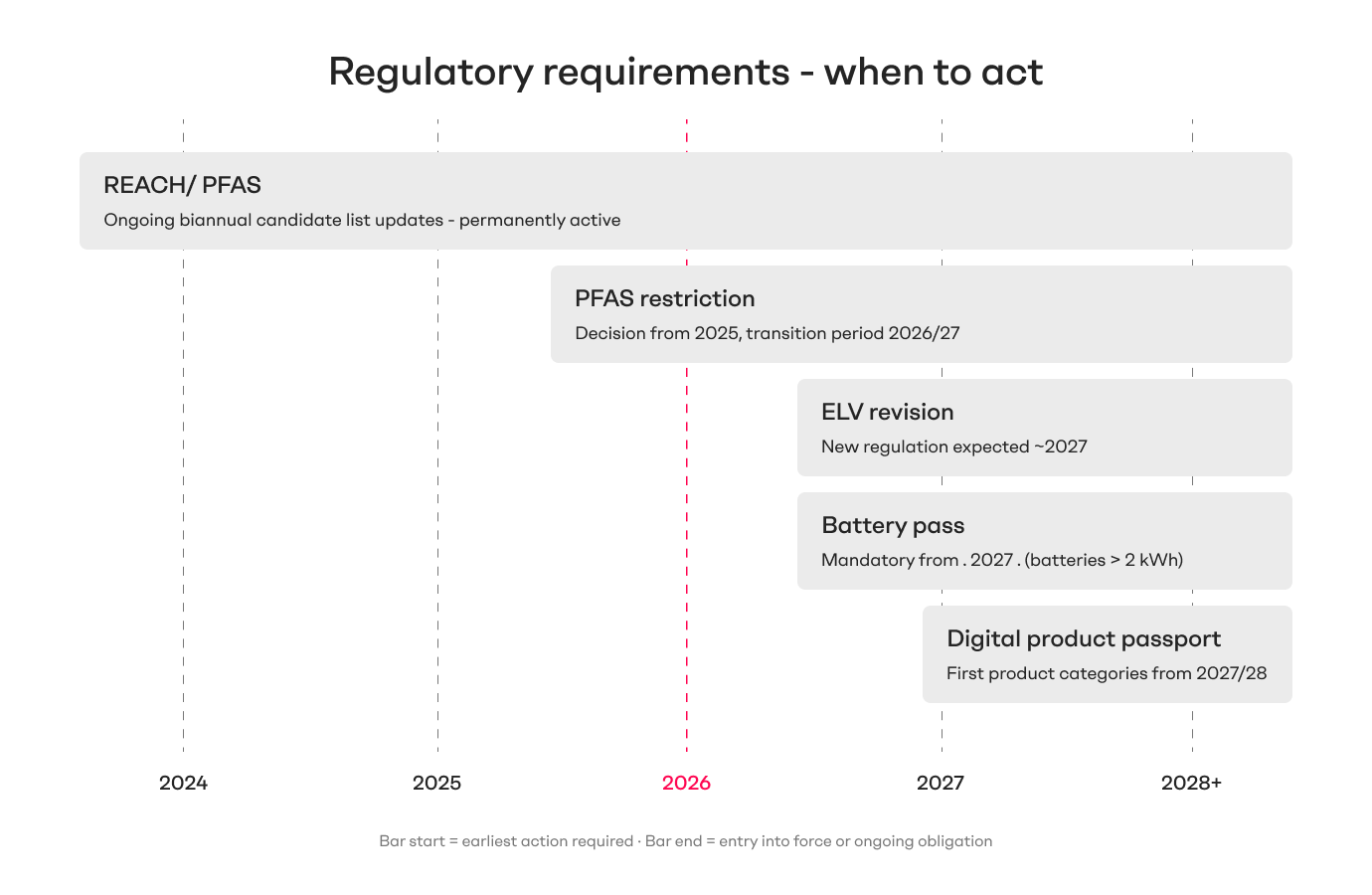
In addition, geopolitical instability and the ongoing shortage of semiconductors are putting additional pressure on procurement markets. Companies face the challenge of not only being compliant, but staying compliant: in real time, along a multi-layered global supply chain.
The real problem is not the knowledge of requirements, but the data
What I regularly hear in conversations with managers from operations, procurement, and engineering is that the real challenge is not knowing the requirements, but the data basis.
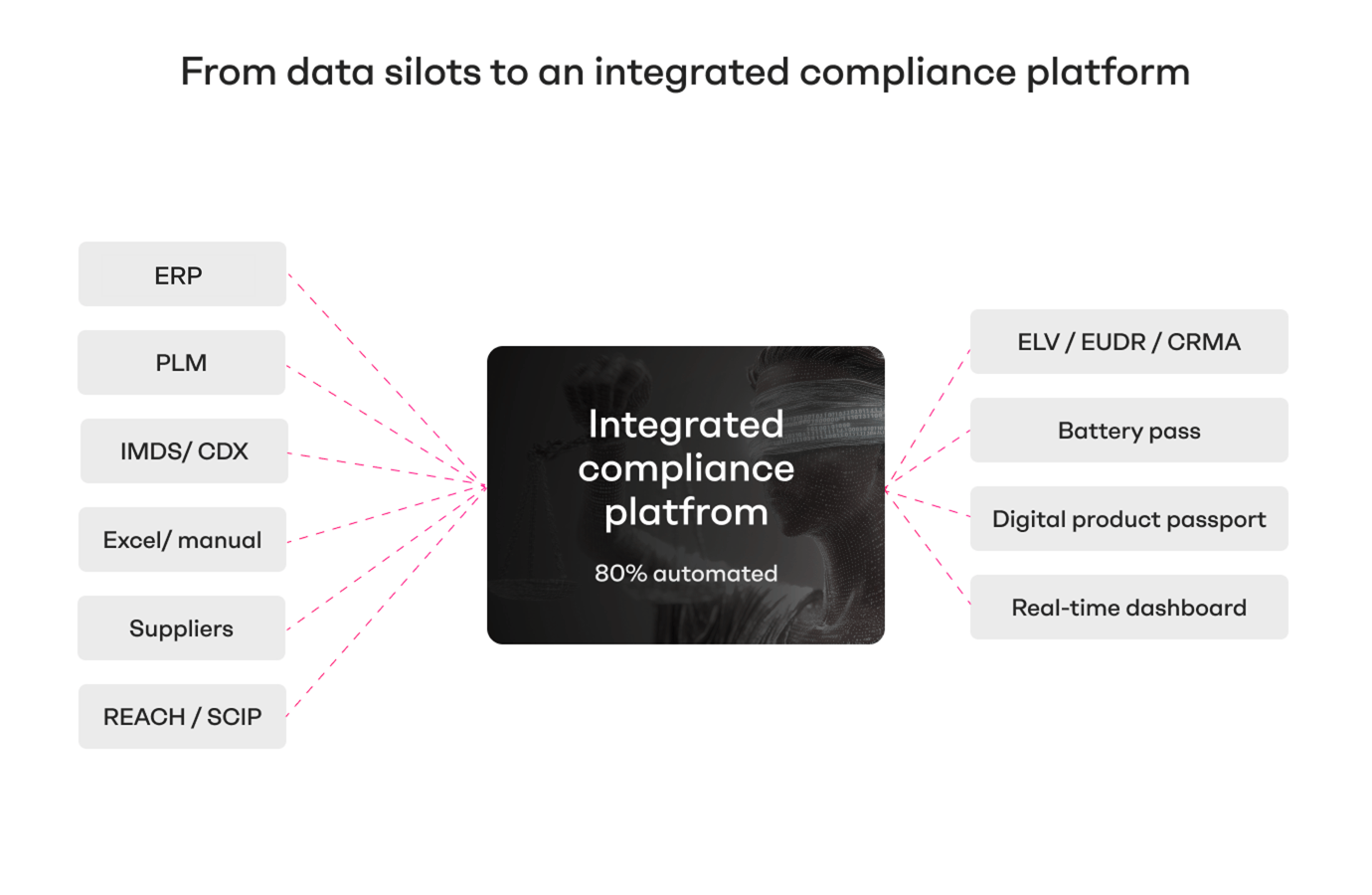
Material data typically resides in:
-
ERP systems - with incomplete material master data
-
PLM solutions - without a direct link to the compliance logic
-
Excel spreadsheets - manually maintained, error-prone, not versioned
-
Supplier portals - with different formats and quality levels
-
External databases - IMDS, SCIP, REACH lists - without automated reconciliation
The result is manual coordination processes that take weeks, a high chance of errors, underestimated risk factors, and a reaction time to new regulations that is simply too slow.

The real compliance risk lies not in the regulation itself, but in the gaps between the systems.
Markus Böhm, CEO Mimacom
What a recent project in the manufacturing industry showed
I would like to make this more concrete by using a project that Mimacom is currently implementing with a manufacturing client whose initial situation is representative of many companies.
The challenge: The client was confronted with a bundle of requirements – increasing compliance complexity due to ELV, EUDR, and CRMA, preparation for the Battery Pass as well as the upcoming Digital Product Passport, all against the backdrop of a volatile procurement market.
The core problem was not a lack of data. It was the lack of connection between the data.
The solution: An integrated compliance platform that consolidates product and material data from different sources, automatically reconciles it, and makes it available for real-time analysis.
| Area | Before | After |
| Data reconciliation | Manual, several weeks | Up to 80% automated |
|
Response time to new regulations |
Weeks | Days to hours |
|
Transparency across critical materials |
Fragmented | Real-time, across products |
|
Compliance risk |
Reactive | Proactively manageable |
Three insights from the project
1. Data quality is not an IT issue, but it is a strategic one.
Without reliable, end-to-end data across products and materials, companies cannot respond to regulatory changes in an agile way. They also cannot make sound sourcing decisions when suppliers fail or when new restrictions affect certain raw materials. Data quality is a prerequisite for the ability to act as a business.
2. Automation does not create compliance, but it makes compliance manageable.
The goal is not to delegate compliance responsibility to a system. The goal is to industrialize recurring, error-prone processes such as data reconciliation, list checks, and supplier inquiries so that capacity is freed up for what actually requires judgment: risk assessment, preparation for new requirements, and strategic sourcing decisions.
3. The next wave is coming sooner than many expect.
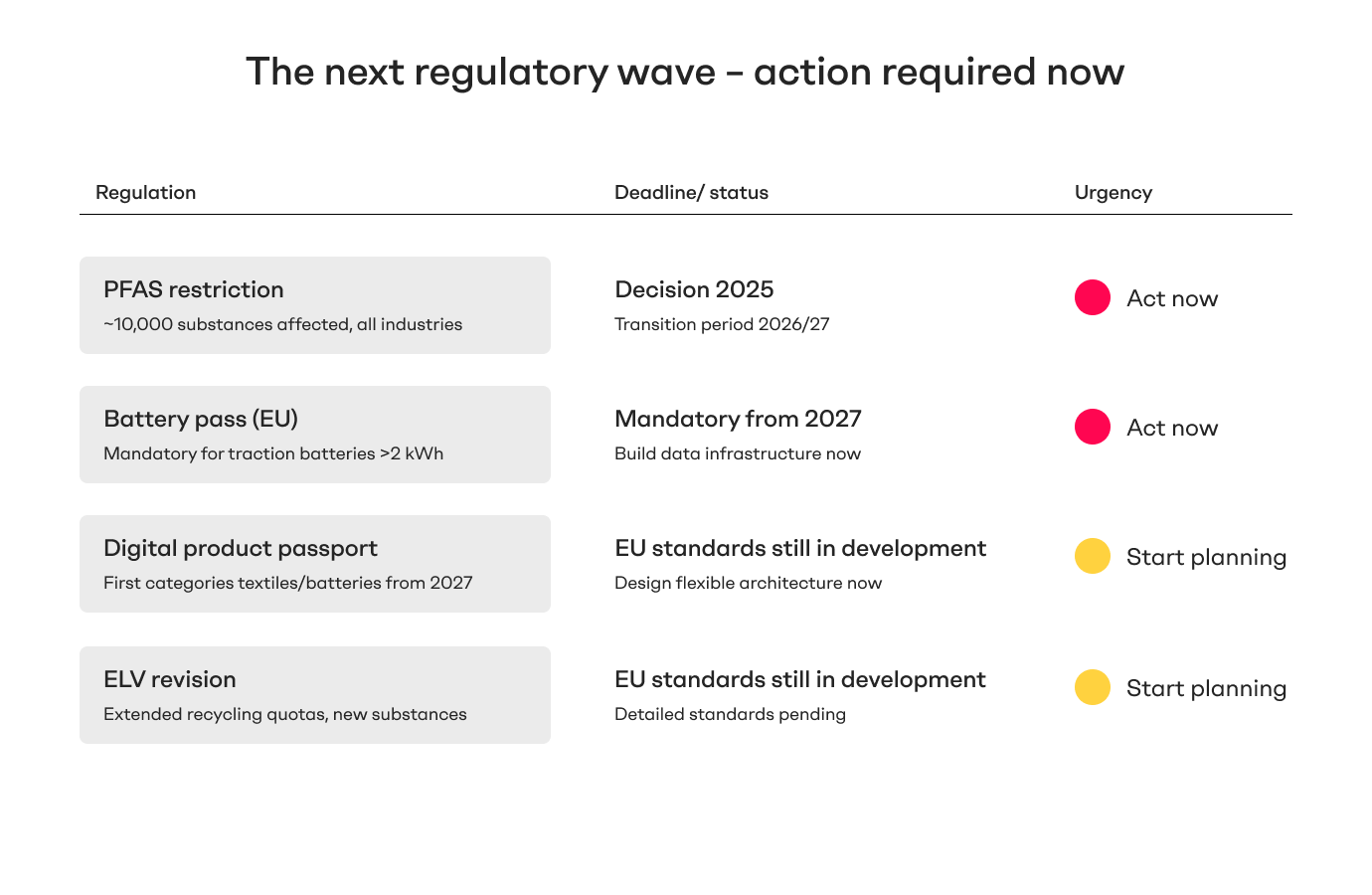
The Digital Product Passport is no longer an abstract vision of the future. The EU Battery Regulation will introduce concrete verification requirements starting in 2027. PFAS restrictions will fundamentally change the material base of numerous industries. Companies that do not align their compliance infrastructure for the future today will face significant pressure in two to three years.
What this means for executives: Five questions to assess your position
I regularly speak with CIOs, procurement leaders, and sustainability managers who have so far placed material compliance in the operational domain. My assessment: this will have to change.
Ask yourself the following questions:
1. How reliable are your material and product data today, and how long does it take to get a complete overview?
2. How quickly can you respond to a new regulatory requirement, in days or in weeks?
3. Do you know today where critical materials such as rare earths or specific semiconductors are used in your products and which suppliers are responsible for them?
4. Are your systems prepared for the Digital Product Passport, or would you have to start from scratch?
5. Do you view compliance data as an operational burden or as a strategic resource for sourcing, product development, and ESG reporting?
Companies that asked these questions early are now in a different position than those that waited. Not because they invested more, but because they invested more intelligently. That is the difference between compliance as an obligation and compliance as a capability.